
By Professor Peter A Jones, MBE: Cruise industry continues to dine out on revenue hoteliers overlook.
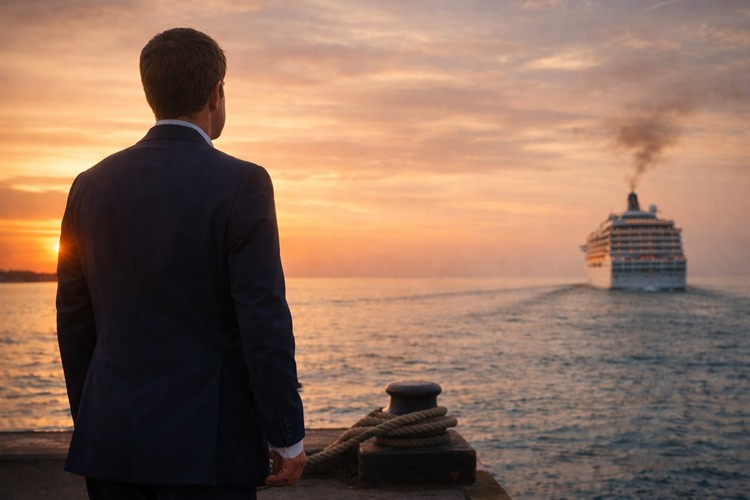
A commercial thought flowed from my personal experience following a recent 14 day cruise with Cunard. A revenue stream that naturally belongs to hotels, served to a growing global demographic that travels frequently, often with companions, and returns service with loyalty, is being dined out on by the cruise industry.
Not because such service cannot be delivered by hoteliers, but simply as a consequence of their overlooking the opportunity.
The commercial reality
The demand for accessible hospitality experiences continues to grow globally across every demographic. Yet stark disparity exists between sectors: cruise liners consistently outperform hotels in providing comprehensive accessibility to guests.
This is not an observation about regulatory compliance, it represents a fundamental difference in how the cruise industry understands, values, and serves guests with diverse needs.
Cruise companies have recognised the commercial opportunity of inclusion.
They have moved beyond viewing accessibility as a legal requirement to embracing it as a core element of customer service and a driver of guest loyalty.
Personal Experience
What became immediately apparent was not the absence of guests with access needs, but their prevalence. Through simple observation, it was clear that a significant proportion of passengers were managing some form of mobility impairment, from uneven gait or reliance on walking aids, to the use of wheelchairs or mobility scooters. Many other disabilities, of course, were present but not visible.
By the end of the voyage, the 41.8 per cent of guests that displayed some form of visible mobility impairment left the experience eager to return soon.
What struck me most during the trip was the absence of tension around accessibility.
Guests did not appear anxious about whether doorways would be wide enough, whether lifts would accommodate their equipment, or whether assistance would be available when needed. These questions had already been answered long before embarkation.
Accessibility was not being negotiated in real time. It had been planned for.
That distinction matters. It transforms accessibility from a source of uncertainty into a source of confidence, and confidence underpins repeat business.
Information replaces reassurance
One of the clearest differences between cruise liners and hotels lies in the level of information provided in advance.
On board, accessibility is specified in detail. Door widths, bathroom layouts, lift dimensions, turning spaces, seating arrangements, and pool access are clearly set out. Guests are able to determine for themselves whether the environment will work for them. This is not about reassurance. It is about transparency.
In contrast, many hotels still rely on a website with broad statements that accessible rooms are available, leaving guests to arrive hoping their needs can be met. Hope is not a booking strategy. Information is.
Planning before arrival is imperative
Another striking difference was the extent to which accessibility needs were addressed before the journey began.
Guests with access requirements completed detailed questionnaires in advance. That information flowed through the organisation. Crew members were not discovering needs at the point of interaction; they were prepared for them.
This enabled practical outcomes:
- tailored embarkation and orientation
- clarity around mobility equipment and storage
- advance planning for shore excursions
- registered emergency assistance where required
In hotels, accessibility needs are often first raised at check-in. By that point, options are limited and pressure is high. What cruise liners treat as planning, hotels frequently treat as improvisation.
Culture reveals intent
The most telling difference, however, was cultural.
Crew members did not wait to be asked before service was provided. Help was offered naturally, without awkwardness or ceremony. This did not feel performative. It felt normal.
That does not happen by accident. It reflects training, expectation, and leadership intent. Accessibility was clearly understood as part of service delivery, not an exception to it.
When space constraints required mobility equipment to be stored safely, practical solutions were found. When ship movement presented challenges, adjustments were made calmly and competently.
This was not about kindness.
It was about capability.
Emergency planning without ambiguity
Emergency preparedness was treated with particular seriousness.
Guests who could not independently reach muster stations were registered in advance and paired with designated crew members responsible for their evacuation. Roles were clear. Responsibility was explicit.
There was no ambiguity about what would happen if something went wrong.
Hotels comply with fire regulations, as they must. Few, however, implement individualised evacuation planning for guests with mobility impairments. The contrast here is not regulatory. It is philosophical.
Loyalty follows confidence
One of the most commercially significant observations was the loyalty displayed by guests with access needs.
When guests feel confident that their requirements are understood and catered for, they return. Often repeatedly. Often with companions. The value of that loyalty compounds over time.
This is not altruism. It is commercially rational behaviour responding to demand.
Accessible environments also benefit far more than a single cohort. Older guests, those recovering from injury, people managing temporary or fluctuating conditions, and multi-generational families all benefit from the same design and cultural principles.
The business model in plain sight
The advantage cruise liners enjoy is not structural, but strategic.
They have recognised accessibility as a revenue model built on confidence, repeat bookings, and trust. They have embedded it into how they think about guests, service delivery, and loyalty.
Hotels can do the same without rebuilding assets or reinventing brands.
Clarity over reassurance.
Preparation over reaction.
Training that builds understanding rather than box-ticking.
Selective investment with disproportionate return.
Emergency planning that reinforces the guest promise.
The model already exists. It is operating successfully elsewhere in hospitality.
A final reflection
Cruise liners are not more accessible to guests because they are kinder, more regulated, or more constrained. They recognise the commercial value of doing so. Demand is proven and the business model works.